The Cost of Assupmtions: False Consensus Bias and Projection
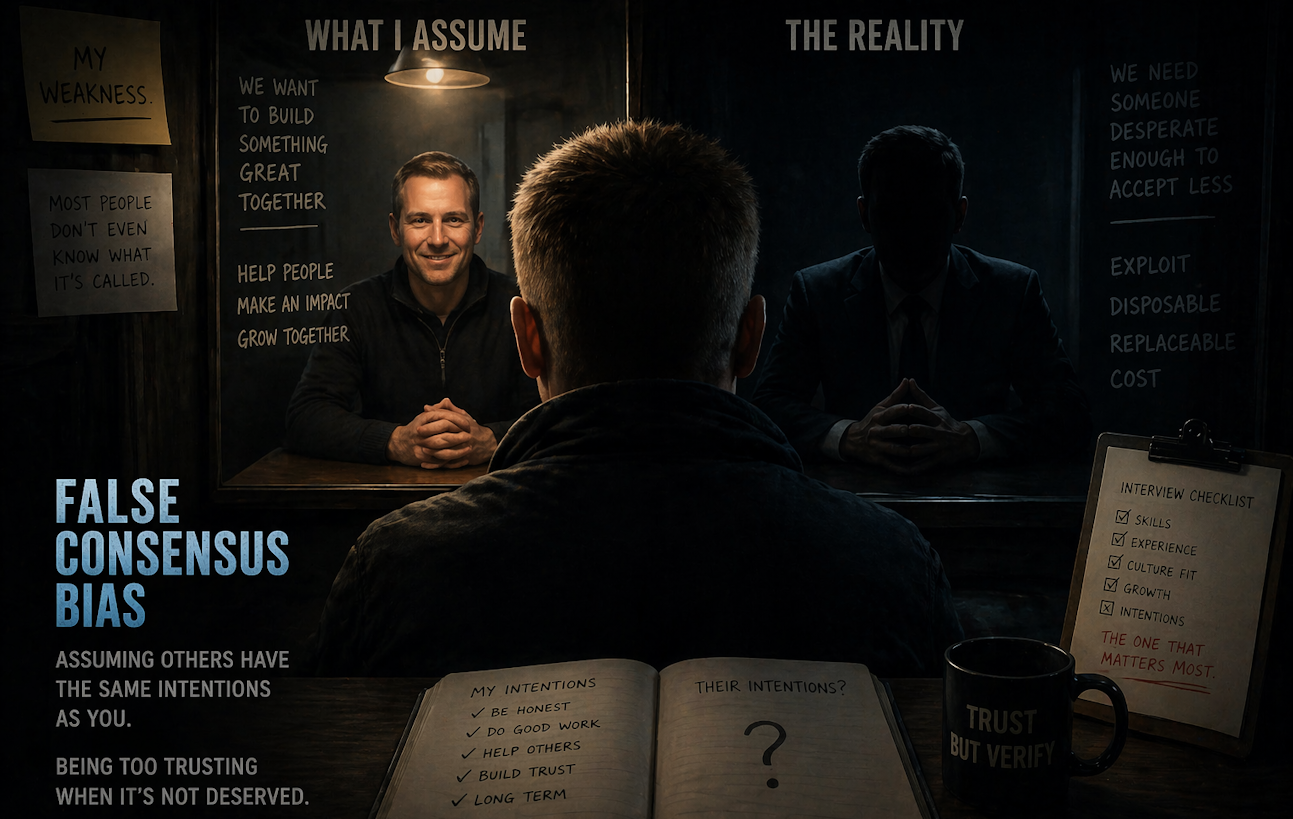
Projection, False Consensus, and the Cost of Assuming Alignment
There’s a specific kind of mistake I make sometimes.
It doesn’t come from being unaware.
It comes from assuming too much.
More specifically… assuming other people think more like me than they actually do.
Not in personality. In standards. That’s where the problem starts.
The Mechanism
Two things are usually at work here:
-
False Consensus Effect
Overestimating how much other people share my values, standards, or way of thinking -
Projection
Assuming my own intentions or internal rules are operating in someone else too
On their own, both are manageable. Together, they create a blind spot.
How the Blind Spot Forms
The process is fairly simple.
I start with my own internal standard.
I treat that standard as normal.
Then I read other people through it.
So when something doesn’t line up, instead of taking the signal at face value, I will soften it.
It gets explained away.
I assume good intentions and reinterpret what happened so it fits the person I thought I was dealing with.
That’s the real mistake. Not missing the signal… but refusing to let it mean what it probably meant.
Integrity and the Assumption of Alignment
A lot of this comes down to the gap between words and actions.
If I say I’ll do something, I mean it.
If I give my word, I treat that as binding.
So the automatic assumption becomes:
if someone says something clearly, they probably mean it the same way I would
That sounds reasonable. It just isn’t universally true.
For a lot of people, words are only used for presentation.
A promise might mean intention.
It might mean optimism or idealism.
It might just be something that sounded right in the moment.
That is not how I opperate and that difference matters.
Because if you treat language as commitment, and someone else treats it as mood… you are not operating inside the same system.
The Practical Consequence
This isn’t just theoretical.
It leads to very practical mistakes:
- defending people longer than they deserve
- missing early warning signs
- overestimating someone’s integrity or reliability
- assuming limits exist where actually none exist
The problem usually isn’t that the evidence wasn’t there. It’s that I didn’t want the evidence to mean what it clearly meant.
Because it conflicted with the model I’d already built of the person.
Why It’s Hard to Catch
The awkward part is that this bias doesn’t feel like a bias. It just feels like common sense. That’s why it slips through.
You’re not thinking:
I am now projecting my standards onto this person
You’re thinking:
surely they wouldn’t do that
But “surely” is doing a lot of damage there. Because that sentence usually has nothing to do with them.
It’s just a disguised version of:
I wouldn’t do that
And those are not the same thing.
Awareness Is the Useful Part
This is also why awareness of it is actually useful. Once you can see the pattern, you can interrupt it.
Not perfectly.
But enough to reduce the damage.
You can stop and ask:
- am I reading their behaviour, or my standards into their behaviour?
- what have they actually shown me so far?
- what evidence is there that they mean what I would mean?
That changes the whole thing.
The bias doesn’t vanish.
It just becomes easier to manage.
From Intent to Evidence
Over time, repeated misreads force a correction.
You stop leaning so heavily on what people say.
You start paying more attention to what they actually do.
That doesn’t mean becoming cynical.
It means becoming more accurate.
Less faith in stated intent.
More weight on repeated behaviour.
That’s not bitterness. It’s calibration.
A Better Question
Instead of asking:
“Would I do this?”
The more useful question is:
“What evidence is there that they would or wouldn’t?”
That removes the false alignment. It stops my own standards from doing all the interpretive work.
Why This Matters
This shows up everywhere.
Work.
Friendships.
Trust.
Judgment.
If you keep assuming alignment where there is none, you end up with:
- bad reads
- avoidable disappointment
- repeated communication failures
- less trust in my own judgement afterwards
Not because my standards are wrong. Because you applied them too broadly.
Maintaining Standards Without Assuming Them
There’s nothing wrong with having standards. The problem starts when you assume they’re shared. Those are two different things.
You need the first.
You need to be careful with the second.
Conclusion
Projection and false consensus are quiet problems. They make other people seem more aligned with you than they really are.
And once that assumption is in place, you start interpreting everything through it.
That’s where the blind spot lives.
Words signal intent.
Behaviour reveals priority.
Alignment has to be verified, not assumed.